


Passover: A Memorial for All Time
A Memorial of His Supreme Sacrifice
Shortly after the resurrection of the Messiah and the death of the early Apostles, a great change took place among those called out to be followers of the Messiah Yahshua.* Generally not realized today is that New Testament worship sprang from roots firmly planted in the Old Testament and grew from the practices of Israel, later found in Judaism. But True Worship would soon decline when Biblical teaching in the growing movement became integrated with pagan concepts. Much of this syncretism or unscriptural mixing is with us today and survives everywhere in churchianity.
Instead of paralleling worship founded in the Old Testament, today’s worship is far removed from Israelite practices and, perhaps more significantly, from the teachings of the early assembly established at Pentecost. When questioned about this disparity, today’s average church member pleads ignorance. Generally unfamiliar with worship found in the Old Testament, today’s churchgoer may contend that modern worship is based on the New Testament only. Hasty appeal is made to Paul’s writings.
Peter warns about indiscriminate use of what Paul wrote, And account [that] the long suffering of our Master [is] salvation; even as our beloved brother Paul also, according to the wisdom given to him, wrote to you; as also in all [his] letters, speaking in them of these things, in which are some things hard to be understood, which the ignorant and the unlearned wrest as [they] do also the other Scriptures to their own destruction, 2 Peter 3:15-16, KJV.
*The Messiah was a Hebrew. His Name reflects His role as Savior and means, “Yahweh is salvation.” He never had a Latinized-Greek name. (Read our study, How the Savior’s Name Was Changed.)
New Testament Passover is Commanded
Perhaps out of ignorance, or more likely by design, there followed a deliberate mistranslation of key words, errors that survive today, in the venerated King James Bible. Partly because of these, churchianity has substituted and twisted the meaning of some plain statements of the Bible.
Remember, that the early Apostles and the Messiah Himself based their teachings and authority on the Old Testament (Mat. 4:4). A blatant example of churchianity’s attempt to divest The King James Bible of what it considered Judaism is found in Acts 12:4, where the word “Easter” appears. The Greek is “Pascha,” meaning the Passover. It has no connection at all with the pagan Saxon deity Eastre or Astarte (Easter), or the Syrian Venus, who is the abominable idol Ashtoreth in the Old Testament.
This grave error demonstrates the early Christian’s goal to have nothing to do with the Jews. Pascha means Passover and newer translations have acknowledged this mistake by translating the word in Acts 12:4 as Passover, and not Easter.
The King James Bible’s problem with Passover does not stand alone. Passover, which marks the beginning of Yahweh’s seven annual Feasts, continues to generate more than its share of controversy not only among those of churchianity, but also among many sincere Bible believers.
Roman Catholics observe their own version of this memorial daily, in what they call the “eucharist” (G.2169, Strong’s Exhaustive Concordance, and meaning expression of thanks, thanksgiving, gratitude) during “Mass” – the Memorial Supper or L-rd’s Supper – observed every Sunday in some churches, by others monthly, quarterly or annually.
Those who understand that this observance is a commanded memorial to be kept once a year in the spring, recognize it as the commemoration of the Passover of Exodus, chapter 12. They also realize that it is a memorial of our Savior’s death, to which the Old Testament observance pointed, and call it Passover as did Yahshua and the disciples.
The Passover (with the seven annual festivals) are to be kept as a statute “forever” (Lev. 23:14). Passover will continue to be observed in the coming Kingdom (Ezek. 45:21). It was kept by both the disciples and Yahshua Himself, in the evening, before His impalement the following morning (Luke 22:11). Paul refers to that Passover night as “the same night in which He was betrayed” (1 Cor. 11:23). Peter tells us to walk in the steps of Yahshua, doing what He did, when He did it, (1 Pet. 2:21).
Yahshua said He would partake of the Passover again with His disciples in the Kingdom, Matthew 26:29: But I say unto you, I will not drink henceforth of this fruit of the vine, until that day when I drink it new with you in My Father’s kingdom, KJV. (See also Mark 14:25; Luke 22:18).
These undeniable facts should leave us without any question, that the Passover is ongoing and for us today in the New Testament! Easter is an erroneous substitute for the true observance of Passover. (See more about Easter at the end of this study.)
Evening Proper for Passover
The Passover memorial is to be observed in the evening and not in the morning as if for breakfast, as some do with their communion. It is to be observed in that month in which green ears of barley appear in the Northern Hemisphere. Passover falls in the Hebrew month of Abib, a word meaning “green ears.” It is a spring month when green ears form on the barley grain (Exod. 9:31).
Passover is determined by the lunar calendar and kept shortly after the day begins, at sunset and not midnight as the custom in the world today. (Read our study When Does the Scriptural Day Begin?)
While some contend that Passover should be kept as the thirteenth ends and the fourteenth begins, other maintain that it should be held as the fourteenth ends and the fifteenth begins. Let us review the entire picture and see what the Bible itself teaches. We must take the Bible for what it says and not force our own interpretation upon the plain statements of Scripture. If our traditional practice is proved wrong by the Scriptures, then we must be willing to change.
A cardinal rule for obtaining clear Bible understanding is to take the first mention of a topic and learn all we can from that introduction. For example, we must understand that Scripturally, days begin with evening or sunset. This fact is told us in the first chapter of Genesis.
It makes sense that the day would end at sunset and a new day would then begin. Not in the middle of darkness or midnight, as in our Roman calendar. With a clear understanding of the beginning and ending of Biblical days, we can better perceive Yahweh’s plan for mankind.
The sun and moon serve as signs for the “moed” or the “appointed seasons,” times that are set aside for the worship of Yahweh. In Genesis 1:14 Yahweh says, Let there be lights in the expanse of the sky to separate day from the night; they shall serve as signs for the set times (moedim)—the days and the years,” *Tanakh.
Even today we should be able to determine when to observe the Annual Holy Days by the heavenly lights and how they affect the earth.
*[Except where noted, quotations from the Old Testament will be from the Tanakh, The Jewish Publications Society, 1985 edition. We will use the Jew’s own translation to present Bible truth, which may contradict present Rabbinical teaching. However, the accuracy and integrity of their Old Testament is readily acknowledged by Bible scholars. Their handwritten copies of the Old Testament were meticulously tested and scrutinized through the centuries, and their English translation is excellent. Rabbinical teachings are often the traditions of men (Mark 7:7).]
Tradition and the Real Thing
We recognize that many erroneous opinions are generated when writers quote or rely upon the customs and traditions of the Jewish Rabbinic teachers who will naturally defend their misguided practices and customs. Neither can we place trust in authors who are ignorant of the Holy Days of Leviticus 23 and who rely upon Pharisaical writings and traditions without further inquiry.
Many attempt to establish the proper time and custom for observing Passover from the New Testament, thinking perhaps it is proper to see how the early disciples and church fathers observed it. This is not the best way. Serious study of Passover must begin in the Old Testament to get the history and background toward better understanding this momentous event. Jumping to the New Testament to study Passover is like attempting to resolve a mystery novel beginning with the third chapter, ignoring the two previous chapters.
For a clear understanding of the Passover commanded by Yahweh Himself, let us begin at square one – the Old Testament. Exodus 12 reveals that the first Passover kept by Israel was in Egypt. It is here that we will glean our basic understanding of that great event. Exodus 12 is the cornerstone of everything that occurred during the original Passover, and the basis for all other celebrations of Passover.
Exodus 12:1-2 tells us, [Yahweh] said to Moses and Aaron in the land of Egypt: “This month [shall] mark for you the beginning of the months, it [shall be] the first of the months of the year for you.”
Still in Egypt, Israel observed “this month” as the beginning of months or the first “moon” of the year. This likely was a special saucer-shaped moon, which it generally is in the spring of the year near the equinox. Israel observed the first Passover in pagan Egypt, not in Jerusalem, and could not for more than 40 years keep it in the Promised Land.
Speak to the whole community of Israel and say that on the tenth of this month each of them shall take a lamb to a family, a lamb to a household. But if the household is too small for a lamb, let him share one with a neighbor who dwells nearby, in proportion to the number of persons: you shall contribute for the lamb according to what each household will eat, Exodus 12:3-4.
Instructions are made for families or households to prepare for the Passover by selecting a proper lamb (the Hebrew word “she” also allows a kid goat) on the tenth day, which was to be kept four days. Ten to twenty people were considered proper for each lamb.
Your lamb shall be without blemish, a yearling male; you may take [it] from the sheep or from the goats. You shall keep watch over it until the fourteenth day of this month; and all the assembled congregation of the Israelites shall slaughter it at twilight, Exodus 12:5-6.
The animal was to be without defect, no spot or blemish, signifying the sinless character of Yahshua, our Passover Lamb. Later, a lamb instead of a goat was always selected. It was to be cared for until the fourteenth day of the month of Abib. The head of the household in the congregation of Israel was responsible for killing the lamb for his family.
Note that the lamb was to be kept UNTIL the fourteenth (“until” is the Hebrew “ad,” meaning “as far as,” “even unto,” Strong’s H.5704). It was not to be kept through to the END of the fourteenth, but up to the beginning of the fourteenth.
The concept is the same when a store takes inventory and posts a sign reading, “closed until Thursday.” It means that when Thursday morning comes, the store is reopened. Stickers placed on packages in December reading, “Don’t open until Xmas” means that the minute that day arrives the packages may be opened.
Protected by the Blood of the Lamb
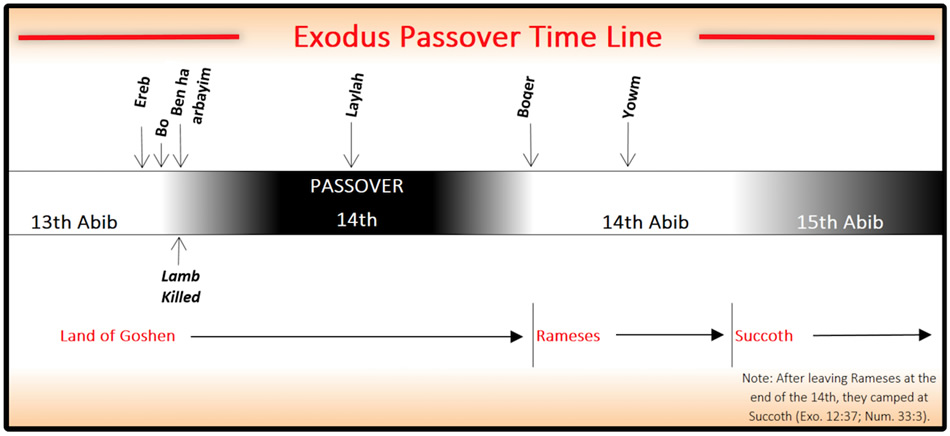
The time to slaughter the Passover lamb was at twilight (or dusk) at the beginning of the fourteenth. Twilight is from the Hebrew beyn-ha-arbayim, literally meaning “between the two evenings.” The first evening was sunset and the second was dark. There was much to be accomplished in the first six hours before midnight of the fourteenth, and no time could be wasted. The consequence of dallying was death. The new day (fourteenth) started at sunset and the lamb was immediately slaughtered at this twilight hour. (More on this later.)
They shall take some of the blood and put it on the two doorposts and on the lintel of the houses in which they are to eat it. They shall eat the flesh that same night; they shall eat it roasted over the fire, with unleavened bread and with bitter [herbs], Exodus 12:7-8.
Israel marked their doorposts and lintels with blood for protection from the destroying angel, the night of the fourteenth. They ate of the roasted flesh on that same night along with unleavened bread and bitter herbs – not the next night, or the following night, but “that SAME night” it was killed, on the fourteenth. (Note that the fifteenth has not been mentioned yet.)
This is how you shall cut it: your loins girded, your sandals on your feet, and your staff at your hand; and you shall eat it hurriedly: it [is] a Passover offering unto [Yahweh]. For that night I will go through the land of Egypt, both man and beast; and I will mete out punishments to all the [deities] of Egypt, I [Yahweh], Exodus 12:11-12.
Yahweh is still discussing the fourteenth. So, when He says He will go through the land of Egypt “that night,” He means on the fourteenth, at midnight, in the same evening the Passover lamb was killed. At Passover the angel “passes over” the land. The blood marks the outside doors of the obedient Israelites. Inside they are worried, apprehensive, and anxious as they nervously eat the Passover lamb with unleavened bread and bitter herbs.
Had Israel waited until the end of the 14th to slay the lamb and keep the Passover, their firstborn would already have been killed by the death angel just as the Egyptians’ firstborn were killed because they lacked the protecting blood.
Passover Kept as a Solemn Festival
This day shall be to you one of remembrance: you shall celebrate it as a festival to [Yahweh] throughout the ages; you shall celebrate it as an institution for all time, Exodus 12:14. Passover falls on Abib fourteen, and is not a holy day, but is to be celebrated along with the annual festivals through the ages. It is to be kept by the people of Yahweh forever. Israelites are huddled in their houses, prepared to leave, but fearful and apprehensive. They do not go out of their houses until morning for the destroying angel is about and busy this night.
Daylight brings a sigh of relief and thankfulness as obedient Israel has survived the destruction of the night. The destroying angel “passed over” their blood-protected houses (Exod. 12:10). Now they can go outdoors to burn the Passover lamb leftover (Exod. 12:22).
Now the Israelites tend to their flocks, gather up their belongings, and prepare to move their families and herds from Goshen to the gathering point at Ramses. They take their dough before it is leavened, and spoil the Egyptians of objects of silver and gold and clothing, with which they clothe themselves.
Those who have traveled with their families to Yahweh’s Feasts know that in spite of preparation, schedules are hard to meet. Not only did the Israelites have to ready the family, but they also had to gather their herds and flocks and meet at Rameses, some 10 or 20 miles distant, according to Bible atlases. Exodus 12:37 reveals that 600,000 men of military age left Goshen. Adding wives, children, grandparents and the aged to that number brings the total to 2-3 million people. It was a monumental task, comparable to moving all the residents of a city like greater Dallas-Fort Worth to a staging area.
Moses was recognized as an outstanding military leader and was appraised of this great undertaking when he was called by Yahweh back in Exodus, chapter 3. With Moses’ experience and guidance from Yahweh, he was able to move this vast throng from Goshen to Rameses during the daylight of the fourteenth.
The Israelites evidently were not told prior to this time to “spoil the Egyptians.” This is a very important point, namely, Yahweh gave prior information to Moses only (Exodus 3:21-22). He outlines His plan of deliverance to His servant Moses who would know what was to come. Surely [Yahweh] Elohim will do nothing, but He reveals His secret to His prophets, Amos 3:7. Notice, however, Moses was told to relay this information only to the elders of Israel –not the general population – at that time. Exodus 3:16-22 includes all the words Yahweh gave to His servant Moses to prepare him for carrying out his task.
The people were not told to spoil the Egyptians until later, just before the last plague fell, as we read in Exodus 11:1-2: And [Yahweh] said to Moses, I will bring but one [more] plague upon Pharaoh and upon Egypt; after that he shall let you go from here; indeed, when he lets [you] go, he will drive you out of here one and all. Tell the people to borrow, each man from his neighbor and each woman from hers, objects of silver and gold.
This is the first time that Moses is allowed to tell the entire congregation of Israel that they are to spoil the Egyptians. Moses told only the elders of Yahweh’s plan before this time, Exodus 3:16. Later, the King James Version reads, “Speak now in the ears of the people” (Exodus11:2a). Up to this point Moses had not made this known, but now – just before Passover – the people shall learn that they are to borrow from the Egyptians.
Unlike Passover, the Following Feast is Joyful
At Rameses all Israel congregated in joyful anticipation, preparing to leave after sunset at the beginning of the fifteenth (Num. 33:3). Happily, they finally leave Rameses for the Promised Land on a full moon night, Deuteronomy 16:1.
Their attitude and outlook had brightened. Passover had been solemn and anxious. The fifteenth of Abib is an entirely different celebration, for this high day is marked by joy and jubilation. The Israelites were spared; their firstborn were alive, in contrast to the dead firstborn throughout Egypt. The Egyptians showered them with jewelry and clothing, and the atmosphere now became festive and exciting.
The first day of Unleavened Bread commemorates the gathering of Israel as a body at Rameses, and on the last day of Unleavened Bread Israel marched through the Red Sea, free of Egypt. The first and last days of Unleavened Bread are memorials of these special days and are High Sabbaths.
A revealing admission is found in the prestigious Encyclopedia Judaica, Vol. 13, under the entry, “Passover,” page 169: “The feast of Passover consists of two parts: namely, Passover ceremony, and the Feast of Unleavened Bread. Originally, both parts existed separately; but the beginning of the exile they were combined.”
The Jewish Encyclopedia on page 553 dealing with Passover and the days of Unleavened Bread says, “Two festivals, originally distinct, have become merged.”
Of “Passover,” the Hastings Bible Dictionary on page 686 says, “Passover is always carefully distinguished from mazzoth [unleavened], which begins on the following day. The celebration is domestic, and not apparently at all connected with the central sanctuary.” Hastings points out that Passover is a family affair, not connected with worship at the central sanctuary. They constitute two separate observances, each on an entirely different night.
The Theological Wordbook of the Old Testament further states, originally, both Passover and the Feast of Unleavened Bread were separate feasts (p. 729).
Sadducees Reject Tradition of 15th Passover
Because of their proximity and the fact that Passover immediately preceded the days of Unleavened Bread, the entire celebration became known as the “Feast of Passover.” Just as in our culture “Xmas holiday” includes the entire season. By their own admission, Jewish authorities confess that their customs in observing Passover a day late on the fifteenth are not Biblical, but are traditions of men. In the Hebrew text, Passover is not called a Feast.
Interestingly, most Jews now keep what they call “Passover Dinner” at the synagogue, as the fifteenth begins, with a bare shank bone on the table. However, many also observe a family ceremony at home called the “Seder” the night before. This is a vestige of the correct Passover time, Abib fourteen. During the Seder service, a ceremony described in Exodus 12:25-27 is enacted by the family even today.
The Sadducees were of the priestly tribe and were in control of Temple worship while the Messiah sojourned upon this earth according to a number of historians. They are reported as keeping Passover on the fourteenth and the first day of Unleavened Bread on the fifteenth. The Sadducees are known for their conservatism, accepting only the written laws of the Pentateuch (the Torah, the first five Books of the Old Testament). They rejected the oral law based on human authority and clashed with the Pharisees over the correct time for both Passover and Pentecost.
An argument is sometimes presented that the proper observance should follow the tradition of the Pharisees, to keep Passover at the end of the 14th as the 15th begins. Supporters of this erroneous teaching go to Matthew 23:2-3: The scribes and Pharisees sit in Moses’ seat: All therefore whatsoever they bid you observe, [that] observe and do; but do not after their works: for they say, and do not, KJV.
The whole context of this chapter is Yahshua’s castigating the hypocritical Pharisees for not doing what the Bible says. They rightly bid the people to observe the laws of Torah written down by Moses, but in practice they themselves disobey. At least eight times, Yahshua scornfully denounced them for being hypocrites in reading the Scripture and following their own customs. In the closing verses of this chapter, He says, “Behold, your house (Temple) is left unto you desolate.”
The later custom of the Pharisees in combining both Passover and Unleavened Bread into a single observance was gaining in acceptance during the time of the Savior. John traces the Savior’s steps after He and the Disciples had partaken of the Passover in John 13. Seized in the Garden, Yahshua was led into the praetorium to be judged. Notice the account given to us:
Then led they [Yahshua] from Caiaphas unto the hall of judgement: and it was early: and they themselves (Jews) went not into the judgement hall, lest they should be defiled; but that they might eat the Passover, John 18:28 KJV.
Here, the Jews were carefully keeping themselves from defilement before they ate their Passover. But the Savior along with His disciples had already kept Passover between the evenings on the fourteenth. The Jews, following the teachings of the Pharisees, were a day late. Today’s Judaism is an extension of the religion of the Pharisees. The Jewish customs of the Pharisees was to observe Passover at the end of the fourteenth and the beginning of the fifteenth.
We will now pursue a deeper study of the Bible’s fourteenth Passover to learn of Yahweh’s unmistakable instruction.
Day Ends and Begins at Sundown
As we have already seen, days begin Scripturally at sundown. Now let us examine the very beginning of the created day in the Bible, returning to Genesis for foundational understanding.
With the setting of the sun, ereb (evening) arrives and the new day begins. Evening begins the 24-hour day: “And there was evening and there was morning …” (Gen. 1:5, 8, 13, 19, 23, 31). Thus, it is clear that Biblical days begin at evening with the setting of the sun and not at sunrise as in ancient Egypt. Leviticus 11:24-25, 22:6-7 and Deuteronomy 23:10-12 say that a man is unclean until he has bathed, the day is over and the sun has set and a new day begun.
As further proof, Leviticus 23:32b clearly describes the proper time to observe the day of Atonement, which begins on the tenth as soon as the ninth ends, “in the ninth day of the month at even, from even unto even, shall you celebrate your Sabbath.” Evening to evening means sunset to sunset.
Here’s more proof that sundown ends one day and begins another day … again, taken from the Book of Judges 14:13-18. For seven days of the wedding feast, the people of Timnah were unable to solve the riddle proposed by Samson. However, just before sunset, which ended the seventh day, they guessed his riddle. Note verse 18a:
“And the men of the city said unto him on the seventh day BEFORE THE SUN WENT DOWN, What is sweeter than honey? And what is stronger than a lion?” (emphasis ours).
The men gave Samson the answer to the riddle at the last minute, at the close of the seventh day just before the sunset. Samson lost out in the last few minutes of the day.
When the Timnah townsmen succeeded in guessing the riddle at the very sunset, end of the final day, an angered Samson killed 30 men of Ashkelon to obtain the promised clothing.
Joshua 8:28-29, 10:26-27 and John 19:31 are in harmony with Deuteronomy 21:23a, “You must not let his corpse remain on the stake overnight, but must bury him the same day.”
The beginning of each day is at sunset bringing in the evening, giving some 12+ hours of darkness preceding daylight. Technically, we can say that every day has only one evening (or dusk or twilight) and it comes first, followed by night and then sunrise and daylight until the next sunset. Request your free Combined Studies booklet, Midnight, Noon or Sunset?
Passover on the Fourteenth, Feast on the Fifteenth
A careful reading of the words of the Tanakh reveals that the Passover and first day of Unleavened Bread are not combined, but are distinguished as separate:
In the first month, on the fourteenth day of the month, at twilight, there shall be a Passover offering to [Yahweh], Leviticus 23:5.
Notice that the Passover offering is made when twilight arrives, which is after sunset at the beginning of the new day of the fourteenth. Verse five concludes the instruction for Passover. The next day, the fifteenth, is the start of the Feast.
Reflecting upon the events of that first Passover, we must perceive there was much to do on the fourteenth. No time could be lost and much preparation had to be carried out beforehand. Preparing the lamb was no easy matter. The lamb had to be eviscerated and the stomach and entrails emptied and washed as commanded in Leviticus 1:9, then stuffed back into the body cavity before being roasted whole.
If it is not cleaned out, methane gas builds up in the lamb’s digestive tract. Those who have ignorantly insisted upon killing a lamb even today for Passover have had their lamb explode when pent-up gas ignited from the roasting fires!
Israelites also had to gather fuel for the roasting fire and prepare a bed of coals for immediate cooking of the entire lamb. There was much preparation to be done and a busy time. Little wonder Yahweh had them start as soon as the fourteenth began at sundown to allow His people maximum preparation time.
The following morning, they removed the Passover leftovers, looked after their herds and flocks, and spoiled the Egyptians, all the while preparing to gather at the Rameses staging area. The day of Passover ends at sunset, and now Israel prepares to leave Egypt from Rameses on the fifteenth. For a better idea of all that took place, see the chart in the center of this booklet.
And on the fifteenth day of the month [is Yahweh’s] Feast of Unleavened Bread. You shall eat unleavened bread for seven days. On the first day you shall celebrate a sacred occasion: you shall not work at your occupations, Leviticus 23:6-7.
Note the fifteenth starts the Feast of Unleavened Bread, which lasts seven days. The first day is a special meeting or gathering of Yahweh’s people just as all Israel gathered as a body at Rameses the next night following Passover. The fourteenth ends at sunset bringing on the fifteenth, which is the first day of Unleavened Bread. (Read our study Why Passover Is NOT a High Day.)
Between the Evenings, Beyn-ha-Arbayim
The Tanakh states the Passover was offered to Yahweh at TWILIGHT, which is from the Hebrew beyn-ha-arbayim. The King James Version has “at even,” a very poor translation of a critical Hebrew idiom. Beyn-ha-Arbayim is literally, “between the evenings.” The first evening is said to start with the setting of the sun, and the second is total darkness. Between sunset and darkness is a period of some 40+ minutes, called dusk or twilight. Later tradition erroneously says that “between the evenings” is any time between noon and sunset. But that is not the definition of beyn-ha-arbayim.
According to authorities, the Hebrew expression, beyn-ha-arbayim, is not found outside the Bible. It does appear at least 11 times in the Bible and is clearly that period of time after sunset when there is enough light to perform necessary tasks such as lighting the lamps just before dark when Aaron burns the incense. Exodus 30:8a reads, “And Aaron shall burn it at twilight [beyn-ha-arbayim] when he lights the lamps—a regular incense offering ...” One would hardly expect the Tabernacle lamps to be lit at noon or even 3 p.m. to burn the precious olive oil needlessly in the brightest part of the day before 6 p.m. or sunset!
As has already been shown, The Jewish Publication Society’s Bible distinguishes between Passover and Unleavened Bread in Leviticus 23:5-6b, “In the first month, on the fourteenth day of the month at dusk is Yahweh’s Passover. And on the fifteenth day of the same month is the Feast of Unleavened Bread unto Yahweh.”
Passover convenes after sunset, the beginning of the fourteenth. Competent Bible translators agree that the Hebrew expression beyn-ha-arbayim does not mean in the afternoon, but the time of twilight after sunset and before dark at the day’s very beginning. This fact is borne out in the following translations of Leviticus 23:5-6a:
The Septuagint: “In the first month, on the fourteenth of the month, between the two evenings, is the Passover for Yahweh.”
The Torah, JPS: “In the first month, on the fourteenth day of the month, at twilight, there shall be a Passover offering to Yahweh, and on the fifteenth day of that month Yahweh’s Feast of Unleavened Bread.”
The New English Bible: “In the first month on the fourteenth between dusk and dark is Yahweh’s Passover. On the fifteenth day of this month begins Yahweh’s pilgrim-feast of Unleavened Bread.”
Rotherham’s Emphasized Bible: “In the first month, on the fourteenth of the month, between the evenings is a Passover unto Yahweh; and on the fifteenth day of this month is the festival of unleavened cakes unto Yahweh.”
The New International Version: “Yahweh’s Passover begins at twilight on the fourteenth day of the first month. On the fifteenth day of that month Yahweh’s Feast of Unleavened Bread begins ...”
Smith and Goodspeed: “On the fourteenth day of the first month at twilight is the Passover to Yahweh. On the fifteenth day of the same month is the feast of unleavened cakes to Yahweh ...”
James Moffatt: “On the fourteenth day of the first month towards evening the Passover of Yahweh begins. On the fifteenth day of the same month the festival of unleavened bread in honour of Yahweh begins ...” Just what Moffatt means by “toward evening” is clarified by his translation of Exodus 12:6, But you must keep it till the fourteenth day of the same month, when every member of the community of Israel shall kill it between sunset and dark.
The Catholic Confraternity: “The Passover of Yahweh falls on the fourteenth day of the first month, as the evening twilight. The fifteenth day of this month is Yahweh’s Feast of Unleavened Bread ...”
The Jerusalem Bible: “The fourteenth day of the first month, between the two evenings is the Passover of Yahweh; and the fifteenth day of the same month is the feast of Unleavened Bread for Yahweh ...”
The New American Standard: “In the first month, on the fourteenth day of the month at twilight is Yahweh’s Passover. Then on the fifteenth day of the same month there is the Feast of Unleavened Bread unto Yahweh ...’
The New World Translation: “In the first month, on the fourteenth day of the month, between the two evenings is the Passover to Yahweh. And on the fifteenth day of this month is the festival of unfermented cakes to Yahweh ...”
The Amplified Bible: “On the fourteenth day of the first month between evenings is Yahweh’s Passover. On the fifteenth day of the same month is the Feast of Unleavened Bread to Yahweh ...”
The New Revised Standard Version: “In the first month, on the fourteenth day of the month, at twilight, there shall be a Passover offering to Yahweh; and on the fifteenth day of the same month is the festival of unleavened bread to Yahweh ...”
Jay P. Greene’s Interlinear: “In the first month, on the fourteenth of the month, between the evenings, (is) the Passover to Yahweh; and on the fifteenth day of this month (is) the feast of unleavened things to Yahweh.”
All good translations tell us the Passover lamb was to be slain on the fourteenth, between sunset and dark, between the evenings. That period was called dusk, twilight, evening, which must be at the very beginning of the fourteenth. On the fifteenth is the Feast of Unleavened Bread. The Bible translators were not out to uphold a doctrine, but simply to render the Hebrew phrase into the most scholarly, faithful English possible.
To force the expression beyn-ha-arbayim to mean any time after 12:00 noon until sunset, which was foisted upon us by later rabbinical teaching, simply is not acceptable, but is rejected by scholarly Hebrew translators. Beyn-ha-arbayim means the time between sunset and darkness. Thus, Passover is after the setting sun ends the thirteenth and brings in the fourteenth. Biblical days begin with the evening.
Furthermore, the related Hebrew word ereb (Strong’s H. 6150) is a prime root in the sense of covering with a texture, meaning “to grow dusky at sundown.” How can it possibly mean the brightest part of the day – early afternoon – when the sun is brightest? Even the “Arab” peoples are known as a “dusky” or dark peoples.
Eating Quail at Dusk, Exodus 16
Exodus 16 relates Israel’s arrival at the wilderness of Sin on the fifteenth of the second month. Most commentaries acknowledge that this was a likely a Sabbath, for Israel is told to count six days, verse five. The grumbling Israelites are informed that their complaining has reached Yahweh and He says in Exodus 16:12: I have heard the grumbling of the Israelites. Tell them, “At twilight you will eat meat, and in the morning you will be filled with bread. Then you will know that I am Yahweh Elohim,” NIV.
Israel is promised that at beyn-ha-arbayim they will eat flesh. In verse six Yahweh says Israel will witness “in the evening” (Hebrew ba-ereb) that it was Yahweh Who brought them out of Egypt. At evening He will perform a miracle.
In verse 13 we see the miracle happen at ha-ereb (evening). The Sabbath was over and Yahweh went to work, providing quail for the Israelites after sunset. That evening quail came and covered the camp, and in the morning there was a layer of dew around the camp. When the dew was gone, thin flakes like frost on the ground appeared on the desert floor, vss. 13-14, NIV.
Here is proof positive. Notice that at evening (ba-ereb) at sunset the quail came in and covered the camp. The Israelites cleaned, skinned and roasted the birds and ate them beyn-ha-arbayim at dusk, just as Yahweh had said. Evening arrived at sunset, and the quail covered the camp, and the Israelites ate meat “between the evenings,” at twilight before it was completely dark. Thus, we can see that beyn-ha-arbayim takes place after sunset, at dusk, and before complete darkness.
“Ba-ereb” (at even, evening) is found in Genesis 1:5, 8, 13, 19, 23, and 31 to mark the days in the beginning of creation. It is also found in Leviticus 23:32b, “from even unto even shall you celebrate your Sabbath.” Beyn-ha-arbayim follows ba-ereb, and comes after sunset.
Strangely, the Tanakh translates Exodus 16:12 as evening, not the more correct “twilight.”
However, their 1955 edition reads “dusk.” The allegation that beyn-ha-arbayim refers to that period of time from noon to sunset is completely false, as this verse proves. Exodus 16 is proof that between the evenings occur only after sunset, ba-ereb. This is the time they were to sacrifice the lamb on the 14th of Abib.
Jewish Writers Confirm Dusk, Twilight
Ben Yehudah’s English and Hebrew Dictionary, page 98, says “dusk” is English for the Hebrew phrase “beyn-ha-arbayim.”
J.H. Hertz, a Jewish commentator who edited the Pentateuch and Haftorah, translated “between the two evenings” in Leviticus 23:5, Exodus 12:6, Numbers 9:1 and 11, as “dusk.”
The Jewish Family Bible according to the Masoretic text (editors Rabbi Morris A. Gutstein, Ph.D., D.H.L. and Rabbi David Graubart D.D., Ph.D.) translates “between the two evenings” as “dusk.”
Dictionaries, in general, define dusk as the time after sunset and before total darkness. Never can dusk be any time after noon until sunset.
The Interpreter’s Bible confirms that the Hebrew expression beyn-ha-arbayim has been reinterpreted by the Jews. The Rabbinical teaching from noon onward is a newer and erroneous teaching. Notice: “The usage of the time referring to that after sunset and before darkness is the older practice” (p. 919).
“Bo”— Going Down of the Sun, Sunset
Before the destroying angel came over Egypt, the lamb was slain at the very beginning of the new day … at sunset, when one day ended. The evidence for the exact time for slaying the lamb at the beginning of the fourteenth is very clear from Deuteronomy 16:6: But at this place where [Yahweh] your Elohim will choose to establish His Name, there alone shall you slaughter the Passover sacrifice, in the evening, at sundown (Hebrew: bo), the time of day when you departed from Egypt, Tanakh. Isn’t this translation admitting that Israel left Egypt at “sundown,” which was the next night after Passover on the fifteenth of Abib?
The word “sundown” is translated from the Hebrew bo (Strong’s H. 935). When used in association with the sun, it has the sense or meaning of set (go in, enter), and is the opposite of sunrise, (go forth, arise). Bo is the proper time to sacrifice the Passover lamb. Israel left Rameses the next night after sundown at the beginning of the fifteenth of Abib.
Clearly the Passover was to be killed as the setting sun ended the thirteenth and also started the next day, the fourteenth.
The following verses illustrate the translation of the Hebrew word bo, which clarify it as sunset or when the sun goes into the horizon according to Brown, Driver and Briggs Hebrew Lexicon:
Genesis 15:12, the sun was about to set; and verse 17, when the sun set; Genesis 28:11, the sun had set; Exodus 17:12, until the sun set; Exodus 22:26, before the sun sets; Leviticus 22:7, as soon as the sun sets; Deuteronomy 23:11, at sundown; Deuteronomy 24:13, at sun down; Deuteronomy 24:15, same day before the sun sets; Joshua 8:29, at sunset; Joshua 10:13, did not press on to set – [hasted not to go down]; Joshua 10:27, at sunset; Judges 19:14, the sun set; 2 Samuel 2:24, the sun was setting; 2 Samuel 3:35, before sundown; 1 Kings 22:36, as the sun was going down.
Thus, Deuteronomy 16:6 in explaining that the Passover Lamb was to be killed at bo, clearly means as the sun sets and another day has begun. Passover starts as the sun sets ending the thirteenth and dusk brings on the fourteenth.
Numbers Proves Passover is the Fourteenth
Yahweh commands Moses: “Let the Israelite people offer the Passover sacrifice at its set time: you shall offer it on the fourteenth day of this month, at twilight, at its set time; you shall offer it in accordance with all its rules and rites. Moses instructed the Israelites to offer the Passover sacrifice and they offered the Passover sacrifice in the first month, on the fourteenth day of the month, at twilight, in the wilderness of Sinai” (Num. 9:2-5a).
Notice Israel was to offer the Passover sacrifice “on the fourteenth day of this month (Abib), at twilight.” This means the Passover lamb was to be sacrificed following the setting sun of the thirteenth, for twilight came and the fourteenth had begun. Had they sacrificed the Passover as the fourteenth ended at twilight, the lamb would have been killed on the fifteenth.
And it was to be offered in “accordance with all its rules and rites.” This means EVERYTHING dealing with the Passover sacrifice was to be done on the fourteenth, “at its set time”: the killing of the Passover lamb, the disemboweling, cleaning of the entrails, stuffing them back in the body cavity, and the roasting thereof. The rites and ceremonies included even more than that.
The eating of it and the unleavened bread all had to be completed on the fourteenth, its “set time.” In no way can one kill it on the fourteenth, roast it on the fifteenth and eat it on the fifteenth and be in accord with Yahweh’s direct command. The fifteenth is a high Sabbath and Passover is the “preparation day” for the first day of unleavened bread. Nowhere are we told we can roast or eat any of the Passover on the fifteenth.
Passover is to be kept:
• By all Israelite people and the foreigner who will join;
• At its appointed time (i.e., the fourteenth day of Abib at twilight);
• In accord with all its rules and ceremonies;
Numbers 9:3 in the King James reads: In the fourteenth day of this month, at even, ye shall keep it in his appointed season: according to all the rites (H.2708 in Strong’s chuqqah = enactment of it, and according to all the ceremonies, H.4941 mishpat = verdict) thereof, shall ye keep it.
Unless you obediently keep the Passover with all the rites and ceremonies and keep them all on the fourteenth, you are disobeying Yahweh! The rites are the chuqqah (feminine of H.2706, from H.2710), enactment as laws, and rendered: appointed, custom, ordinance, site, statute. Anything commanded by Yahweh dealing with the Passover it to be accomplished on the fourteenth. Anything left over was to be disposed of in the morning (Hebrew: boqer) or daylight of the fourteenth.
The “ceremonies” are from Strong’s H.4941, “mishpat,” from H.8199, “verdict.” It means a verdict pronounced judicially, especially a sentence or formal decree ... including the act, the place, the suit, the crime, and the penalty. Both words carry the meaning of judicial enactment of those things involved in Passover. There is no middle ground in keeping the Passover. It is to be done exactly as Yahweh has commanded and to be completed on the fourteenth of Abib.
Numbers 9:11b reads if one is defiled or on a long journey, he then “shall offer it in the second month, on the fourteenth day of the month at twilight.” Similarly, the second month’s Passover is offered at twilight (after sunset of the thirteenth) as the fourteenth begins. Clearly, the Passover is a very important rendezvous with Yahweh, which He fully expects His people to observe.
Notice Numbers 28:16-17: In the first month, on the fourteenth day of the month, there shall be a Passover sacrifice to [Yahweh], and on the fifteenth day of that month a festival. Unleavened Bread shall be eaten for seven days. The first day shall be a sacred occasion: you shall not work at your occupations.
On the fourteenth of Abib is the Passover sacrifice. On the fifteenth of the month is the festival. There are two separate observances, the Passover sacrifice to Yahweh followed by the festival (feast) of Unleavened Bread (Hebrew chag, H.2282, from H. 2287, a joyful, merry time).
Hezekiah kept the Passover in the second month because there was not sufficient time to sanctify the priests. We read in 2 Chronicles 30:15a, “They slaughtered the Paschal sacrifice on the fourteenth of the second month.” Verse 21a reveals, “The Israelites who were in Jerusalem kept the Feast of Unleavened Bread seven days, with great rejoicing.”
They were so joyful, they kept the Feast an additional seven days – Passover was not included! Verse 23 declares they kept seven more joyous days.
In Josiah’s time we learn, All the Israelites present kept the Passover at that time, and the Feast of Unleavened Bread for seven days, 2 Chronicles 35:17 (emphasis ours). Please note that they kept the Passover first, followed by the Feast of Unleavened Bread for seven days.
When the Jews returned from Babylon, we read, The returned exiles celebrated the Passover on the fourteenth day of the first month, Ezra 6:19. In verse 22 we read they then “joyfully celebrated the Feast of Unleavened Bread for seven days.” These are two separate occasions.
‘Asah’ and the Erroneous Fifteenth Passover
To cling to the erroneous concept of keeping Passover on the end of the fourteenth, some seize
upon the word Hebrew asah (aw-saw) Strong’s H. 6213. They wrongfully maintain that asah does not mean to celebrate, but to prepare or kill. They contend asah means only prepare or kill and does not mean to eat or partake of the Passover meal. With this false premise they build a case saying the Passover lamb was killed or prepared on the fourteenth but eaten on the fifteenth.
Asah is variously translated and emphatically stated in Strong’s that it is used in the widest application from preparing to the broadest sense of feasting, keeping, perform, practice and many other meanings.
Brown, Driver, Briggs Hebrew Gesenius has almost four complete columns given to the meaning of asah. It is used much like our English word “do.” Asah appears in 2 Chronicles 30 dealing with king Hezekiah keeping the Passover in verses 1, 2, 3, 5, all referring to celebrating the Passover, not merely killing or preparing the Passover.
Verses 13 and 23 use asah in reference to the days of Unleavened Bread with no killing mentioned. Exodus 31:16 and Deuteronomy 5:15 both use asah referring to the Sabbath, with no slaughter mentioned. We cannot limit asah only to mean kill or prepare. It means to observe, keep, celebrate, do, and perform.
Wilson’s Old Testament Word Studies says asah means “to do, make, &c., to observe; see observe.” Under “observe” we read, “to do; to observe the Sabbath, &c., implies those active duties required on the Sabbath.”
If we are told someone does not keep or “do” Xmas, does that means he just does not eat Xmas candy? Or does it mean he has nothing to do with this pagan holiday? If we are told someone does not keep or “do” birthdays, does that mean he refrains just from eating birthday cake? Or does it mean he dispenses with the entire affair? As we have clearly seen in Numbers 9:1-5, Israel observed EVERYTHING connected with the Passover on the fourteenth – killing, roasting, eating.
Unleavened Bread and Passover Are Separate
When Yahweh made the covenant with Israel, not only did He give them the Ten Commandments, but also commanded they observe the Feast days as a part of that Covenant. The celebrations of these High Sabbaths begin with the days of Unleavened Bread, which follow Passover, and continues with Pentecost and Tabernacles.
In Exodus 23:14-17 we read, Three times a year you shall hold a festival for Me. You shall observe the Feast of Unleavened Bread – eating unleavened bread for seven days as I have commanded you – at the set time in the month of Abib, for in it you went forth from Egypt; and none shall appear before Me empty-handed; and the Feast of Harvest of the first fruits of your work, of what you sow in the field; and the Feast of the Ingathering at the end of the year, when you gather in the results of your work from the field. Three times a year all your males shall appear before the Sovereign [Yahweh].
Interestingly, Passover is not mentioned here at all! To be sure, Yahweh expects His people to keep the Passover first. That is understood. Yahweh starts with the Feast of Unleavened Bread to commemorate their gathering at Rameses on the first day of the crossing through the Red Sea on the final day of Unleavened Bread. He then follows with Pentecost and the fall feasts to emphasize His plan of salvation.
The daylight portion of Abib 14 was spent spoiling the Egyptians as families of the redeemed gathered their flocks and herds as a body at Rameses some 10-20 miles away. They were stationed in a military marching order by Moses (“ordered host,” Exodus 12:41) with their flocks and herds, readied for their trek out of Egypt. On the last day of the seven days of Unleavened Bread they crossed over the Red Sea and were completely free of Egypt.
The days of Unleavened Bread are very important to Yahweh. Notice that in Exodus 34 where He rewrote the tablets of the Covenant, Yahweh again commands Israel, You shall observe the Feast of Unleavened Bread – eating unleavened bread for seven days, as I have commanded you – at the set time of the month of Abib, for in the month of Abib you went forth from Egypt, Exodus 34:18. Here we again find that Passover, as in Exodus 23:14-17, is not mentioned. Passover is a separate celebration kept as a family and has a different meaning. These two are not to be combined as a unit. The Feast of Unleavened Bread, which follows, is a gathering of all Israel.
The above in no way is meant to imply that Passover is to be ignored or forgotten. It is actually so important that it is the sole observance one can keep later if for some reason one is unable to participate in its observance. Obviously, Israelites are so dedicated in keeping Passover that it was a foregone conclusion that it would be celebrated, followed by the Feast of Unleavened Bread. If an Israelite did not keep it, he was cut off (Num. 9:13).
Because of the ignorance of the early Bible translators, the King James Version lacks the finer definition or better translation of some very important Hebrew words. The translators were not schooled in Hebrew, and cared little for the religion of ancient Israel. In fact, we read that they detested the Jews.
Seven Days, Not Eight
Let us carefully examine the charge we teach eight days of unleavened bread. The issue is that if we eat unleavened bread with the Passover, and then eat unleavened bread for seven more days, then we eat bread for a total of eight days, while the Bible demands only seven days of unleavened bread.
Deuteronomy 16:2-3 answers and clarifies the issue. The Bible teaches us to eat unleavened bread with the Passover, and an additional seven days of unleavened bread following Passover.
The Tanakh and Torah, two Jewish publications, clearly show that Passover is followed by seven days of Unleavened Bread: You shall slaughter the Passover sacrifice for [Yahweh] your [Elohim], from the flock and the herd, in the place where [Yahweh] will choose to establish His Name. You shall not eat anything leavened with it; for seven days thereafter you shall eat unleavened bread, bread of distress – for you departed from the land of Egypt hurriedly – so that you may remember the day of your departure from the land of Egypt as long as you live, Deuteronomy 16:2-3.
The Jewish Publication Society’s Torah (The five books of Moses) emphasizes, You shall not eat anything leavened with it (Passover); for seven days thereafter you shall eat unleavened bread, bread of distress—for you departed from the land of Egypt hurriedly—so that you may remember the day of your departure from the land of Egypt as long as you live, Deuteronomy 16:3.
The King James Version reads, “Seven days shalt thou eat unleavened bread there- with” (therewith, meaning seven days in addition to the Passover) – seven additional days eating unleavened bread following Passover!
The Passover was a family gathering, eating the lamb with unleavened bread and bitter herbs. The days of Unleavened were spent in convocation with the entire nation of Israel. These are two separate observances.
After partaking of the Passover on the fourteenth, for seven days thereafter, unleavened bread is eaten. The first day of Unleavened Bread, the fifteenth and the last day of Unleavened Bread, the twenty-first are High Sabbaths.
It should be noted that this is the second giving of the law (i.e., Deuteronomy) to a new generation going into the Promised Land, spoken to as if they had themselves been in Egypt. Celebrating (keeping) the Passover brings us a sense of having been there with them.
Sunrise? Sunset? Midnight?
Does it matter when the day begins, Scripturally? Of course, it does. Feast and Sabbath observances depend on it. And so does Almighty Yahweh. Discover how your Creator determines the beginning and ending of the day. Read our booklet, When Does the Scriptural Day Begin?
Passover in the New Testament
Our Savior gave us the example of observing the Passover. It is rather disturbing to learn that many of those advocating an erroneous fifteenth Passover contend that Yahshua never partook of the Passover with His disciples. Some will grudgingly admit He was there, but maintain it was the disciples alone who observed the Passover.
Yahshua did indeed partake of the Passover and then gave them new symbols by which to recall His suffering and death. Yahshua gave them a whole new order of things – unleavened bread and the fruit of the vine – so that after His death, the Holy Spirit would impress on their minds the symbols by which to remember Him.
Because of the erroneous belief that the Pharisees kept the Passover at the proper time, the allegation is made that Yahshua had to institute new symbols to His disciples a day early. However, the facts are that His death was sealed when Judas kissed Him and He was taken prisoner. He died as the Jews killed their lambs while keeping the Passover a day late.
Was Yahshua a sinner? No way. Then why is He falsely accused of not partaking of the Passover before He was put to death? Notice the clear warning from the very words of Yahweh in Numbers 9:13, But anyone who [is] clean and is not on a journey, and yet refrains from keeping the Passover, shall be cut off from the people for not presenting [Yahweh’s] offering at its appointed time; such a one shall bear the consequences for the sin, NIV.
Had Yahshua not partaken of the Passover, He would be a sinner! The Bible is clear that He had to follow every commandment up to the very time of His death (John 15:10). If He did not obey every little yothe and tittle in the law, then He is not our Savior! How could He be the sinless salvation of the world if he did not take the Passover (which is commanded forever) and thus bring condemnation upon Himself? He had to be the perfect sacrifice, without spot or blemish or sin. And He was!
The disciples knew that Yahshua would be keeping the Passover to Yahweh and when the time drew near inquired about preparing for the Passover. He confirmed that He would indeed keep the Passover at a certain house as shown in the following verses:
On the first [day] of Unleavened Bread the disciples came to Yahshua, saying, “Where do you want us to make the preparations for you to eat the Passover?” He said Go into the city to a certain man, and say to him, “The Teacher says, ‘My time is near; I will keep the Passover at your house with My disciples,’” Matthew 26:17-18, NRSV.
The parallel account in Mark reads, “The Teacher asks, where is my guest room where I may eat the Passover with my disciples ... Make preparations for us there” (Mark 14:14-15).
Luke 22:7 reads the Messiah saying to Peter and John, Go and prepare the Passover meal for us that we may eat it. Of the owner of the house they are to ask, “The Teacher asks you, ‘where is the guest room where I may eat the Passover with my disciples?’” NRSV.
Later we are told in Matthew 26:20-21, at evening, Yahshua took His place with the twelve, “and while they were eating ....” Verse 26 again reveals, “While they were eating ...” NRSV.
Mark 14:18 reads, And when they had taken their places and were eating, [Yahshua] said, “Truly I tell you, one of you will betray Me who is eating with Me.” Mark 14:20 reveals, “... It is one of the twelve, one who is dipping bread into the bowl with Me,” NRSV.
In Luke, Yahshua says, With desire I have desired to eat this Passover with you before I suffer. For I say unto you, I will not any more eat thereof, until it be fulfilled in the Kingdom of Yahweh, Luke 22:15-16 KJV. Regarding the cup, Yahshua said, For I tell you from now on I will not drink of the fruit of the vine until the kingdom of Yahweh comes, vs. 18 NRSV.
It is difficult to comprehend how one can read these plain statements of Scripture and then erroneously contend that Yahshua did not partake of the Passover that night. There can be no doubt. He did indeed partake of the Passover with His disciples!
He partook of the Passover as an example to you and me that we should walk in His footsteps (1 Pet. 1:21). He was baptized for the same reason, so we would also follow His example. Keeping all of Yahweh’s Laws, He was without sin. He did not need to be baptized for the remission of sin. But He was baptized (Matt. 3:15-17) and partook of the Passover to fulfill all righteousness.
All Israelites were commanded to keep the Passover (Exodus12:24). So important was Passover, that if one missed the first month for reason of being ritually unclean for having come proximate to the dead or was on a journey, Passover could be taken the second month, as was the case with Hezekiah in 2 Chronicles 30:2-13.
If Yahshua did not keep the Passover as commanded, then He was condemned according to Numbers 9:13. But, Peter says He was without sin (1 Pet. 2:22). Yahshua did eat of the Old Testament Passover as commanded, and then revealed to His disciples exactly what they should do at Passover henceforth in remembrance, by instituting new symbols of Him (1 Cor. 11:24-25).
A Little Greek, a Big Mistake
Knowing a little Greek can be a dangerous thing. One Bible teacher contends that Yahshua did not partake of the last Passover, claiming the ancient Greek letter omega (looks like a rounded w) was added to the verb phag (o) (=eat) by the translators in Mark 14:14 and other places. With this letter, he contends, the translators changed the meaning to the first person, “I eat.” The first question that comes to mind is, for what reason would the translators deliberately change this verb ending from some other ending?
Any student of Greek has had to learn the conjugation of verbs and knows the omega ending stands for the first person singular, “I.” The same principle of endings is true in Latin and other languages.
Many words have the omega suffix added to the verb in the Greek text, such as Mark 14:18b, where we find the Greek lego, = say. “I say (lego) unto you, one of you who is eating with me shall betray me.”
Denying that the Greek says that Yahshua ate of the Passover is the highest of deceptions! It is an outright error either through ignorance or design. Rest assured, the New Testament Greek shows that the Savior did fulfill all righteousness and partook of the last Passover (John 15:10).
We should rely on the academic community of Bible scholars, grammarians, and linguists before we take the word of some obscure group out to make a name for themselves by blindly bludgeoning the ancient languages!
Keep Passover When Yahshua Died?
The Bible reveals that our Savior died about three o’clock (“... about the ninth hour ...” Matt. 27:46) the afternoon of the preparation day as He hung on the tree. There are those who mistakenly contend we must celebrate Passover at that exact time of His death (3:00 p.m.), supposing this acknowledges He is indeed our Savior.
Nowhere does the Bible say that we are to celebrate Passover at the hour Yahshua died. To do so, is a perversion of Scripture. It is a forced interpretation; man’s invention and totally without foundation.
Similarly, Sunday became a special day among Christians, presumably to celebrate the resurrection of the Messiah on the first day of the week. This day-late Sunday observance is not from the Bible. It also is an added, man-made doctrine, as is the fifteenth-day Passover. Christmas, as well, became a man-made addition to early churchianity in celebration of the birth of the Savior. Nowhere are we told to celebrate His birth. (Read our in-depth study, The Untold Story of Christmas.) We are told to remember His death, which we do as we observe Passover the same night He did on which He was betrayed (1 Cor. 11:23).
We are to observe the Passover when the Bible tells us to observe it (Lev. 23:5-6) ... that is, after sunset on the fourteenth of Abib, which is a statute for all generations (v. 14). To select some other time is not Biblical, and is in fact, rebellion against Yahweh’s Law. We are to walk in the Savior’s footsteps; doing what He did; when He did it. For He is our example, “that we should follow in His steps” (1 Pet. 2:21). In Matthew 5:17, Yahshua said, “He came to fulfill the law.” He kept the Passover in accordance with the law, lest He, too, should be cut off (Num. 9:13).
Yahshua Died on Preparation Day, Fourteenth Abib
All four of the Evangels say the Savior was put to death on Passover, and the Jews wanted the body taken down immediately because the coming day was a High Sabbath, John 19:30-31:
When [Yahshua] had received the [sour] wine, He said, “It is finished.” Then He bowed His head, and gave up His spirit. Since it was the day of preparation, the Jews did not want the bodies left on the tree during the Sabbath, especially because that Sabbath was a day of great solemnity. So they asked Pilate to have the legs of the impaled men broken and the bodies removed, NRSV.
The fifteenth is a High Sabbath, the first day of Unleavened Bread. Therefore, Passover being on the fourteenth comes first and is the preparation day for the first day of Unleavened Bread. In fact, whenever “Preparation Day” is mentioned in the Evangels, it refers to the day of Passover to prepare for the first day of Unleavened Bread. Passover is not a High Sabbath.
We keep the Passover when He did and follow His perfect example of sinless behavior. We recall the suffering and torment he endured and the tremendous price He paid for our sins as we partake of the emblems of His body and blood at the beginning of Abib fourteen.
The Savior died on Passover day. And that day was the preparation, and the Sabbath drew on, Luke 23:54 KJV.
Sunset would begin the High Day, Thursday, the first day of Unleavened Bread. And Joseph of Arimathaea and Nicodemus as well as the pious Jews wanted the body taken down hurriedly because sunset began a new day which was a High Sabbath, an annual Holy Day.
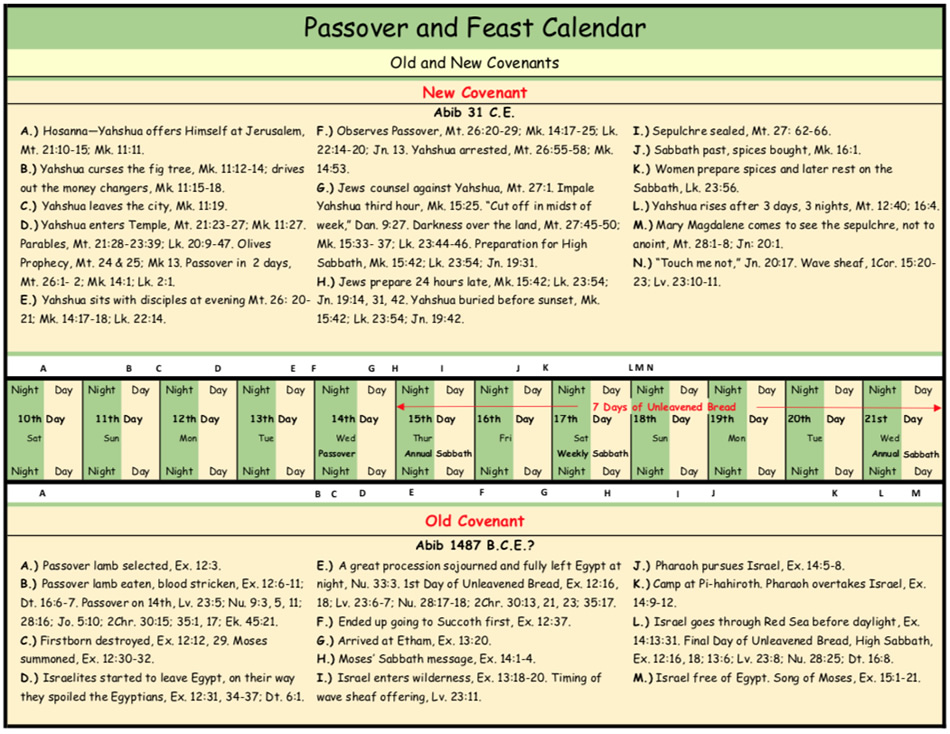
The day after the Passover was not the weekly Sabbath or Saturday. He was not killed on a “Good Friday” but on a Wednesday, about 9 a.m. on the fourteenth of Abib, our preparation day and died at about 3 p.m., “about the ninth hour” (Matt. 27:46) and was hurriedly placed in the tomb, His body hurriedly wrapped in linen along with myrrh and aloes for temporary embalming, just before the High Day of the fifteenth arrived at sundown. He would rise from the dead three days and nights later (Matt. 12:40) at the end of the weekly Sabbath (see chart on pp. 22-23)
The Dictionary of the New Testament reveals several Jewish scholars admitting Passover was held on two consecutive dates in 31. CE, when our Savior was impaled. Obviously, the Savior observed the Passover correctly on the fourteenth as regulated by the Sadducees, then in charge of Temple worship. He ignored the second Passover, or the Pharisees’ erroneous fifteenth-day Passover, and which is followed by the Jews today.
Changes in Observing Passover
Over the years gradual changes in customs occurred with keeping the Passover. While in Egypt, in a foreign land, Israel kept the Passover with apprehension and fear, for the destroying angel was about, passing over the land destroying the firstborn of every creature. There, in Egypt, Israel was commanded to remain in their houses until morning until the work of the “Destroyer” was completed.
In the New Testament, we find the disciples in an upper room – not dressed for travel ... with shoes on their feet and “staff in hand” – reclining on couches partaking of the Passover (John 13:23-25). This first Passover in Egypt, Israel observed standing. But once free of Egypt, they could keep the memorial without apprehension or fear.
Deuteronomy 16:1-6 shows that the Passover is to be kept where Yahweh places His Name. Now it is kept wherever the baptized Body of Messiah has properly gathered. Those immersed into Yahshua’s Name also carry the Name of the Father as well, for the Savior’s Name means “Salvation of Yah.” (Read our study, How the Savior’s Name Was Changed).
Throughout time, certain traditions had been incorporated in the Passover observance. The singing of the Hallel Psalms 113 and 114 were customarily sung before the Passover, and 115-118 following it. Yahshua and His disciples probably sang these same Psalms (Matt. 26:30).
Fruits reduced with vinegar likely made up the sauce in the dish. It symbolized the mortar Israelite slaves used in Pharaoh’s building program. Four successive cups of fruit of the vine diluted with water were also added.
In Deuteronomy 16:7, it says, “And you shall turn in the morning, and go unto your tents” KJV. “Then in the morning you may set out for home” Moffatt. This obviously follows Passover night, for they were to remain there all-night and return the next morning to wherever they were staying. This is obviously referring to the “night to be remembered,” Passover night.
Passover Was Kept Before He Suffered
After the Savior and His disciples had partaken of the Passover, they evidently sang a Hallel Psalm and went to the Mount of Olives, Matthew 26:30. On three occasions He chided them for falling asleep as He went to pray, verses 38-45. He had specifically asked them to watch with Him, verse 38. The custom was to stay awake all night as a reminder of Israel’s first Passover in Egypt. Anyone falling asleep brought an end to the “night of watching.”
Those who insist upon eating the Passover on the fifteenth are not following the example of the Savior. We are to observe Passover according to all the rites and ceremonies of it on the fourteenth as commanded in the Old Testament.
Those who keep it a day late are perverting this observance as much as those who celebrate Easter to remember Yahshua’s resurrection. Sunday worship – keeping the Sabbath a day late to remember His resurrection – follows the same! He never told us to observe His resurrection on a special day each year (it was not on Sunday regardless; see pp. 22-23). We are to remember His death. (Read Our Savior’s Resurrection.)
And when the hour was come, He sat down, and the apostles with Him. And He said to them, WITH DESIRE I HAVE DESIRED TO EAT THIS PASSOVER WITH YOU BEFORE I SUFFER, Luke 22:15 KJV (emphasis ours). He had commanded His disciples to prepare the Passover. He desired to eat the Passover BEFORE He suffered. When did He suffer? His horrendous ordeal began shortly after He partook of the Passover on the fourteenth, when “His visage was so marred more than any man, and His form more than the sons of men” (Isa. 52:14 KJV). He was spat on, ridiculed, beaten, struck, stoned and severely bruised and beaten before being impaled on the torture stake.
Therefore, to follow in His steps we should eat the Passover as He, before He suffered – after sunset, the beginning of the fourteenth – so we can share in, and remember His suffering and death He had yet to experience. He and His disciples kept it BEFORE He suffered, not when He died!
We learn that the women returned. After the High Sabbath was over, on Friday they bought spices to finish embalming the body of Yahshua (Mark 16:1). And prepared spices and ointments; and rested the [weekly] Sabbath day according to the commandment, Luke 23:56.
The women came to the tomb to complete the embalming process early on the first day of the week (Luke 24:1-7). They found the stone rolled away and were told by the two messengers in shining garments that He was gone, He had arisen.
Matthew 26:4-5 proves that Yahshua did not die during the Feast of Unleavened Bread, but He died before the Feast: And they plotted to arrest Yahshua in some sly way and kill Him. But not during the Feast, they said, or there would be a riot among the people, NIV.
John reveals that the Feast had not started, and that the Preparation day (Passover) is not a High Day. Note:
But no one at the meal understood why Yahshua said this to him, since Judas had charge of the money, some thought Yahshua was telling him to buy what was needed for the Feast or to give something to the poor. As soon as Judas had taken the bread, he went out. And it was night, John 13:28-30, NIV.
When Yahshua offered the dipped morsel to Judas, it was at the Passover and not during the Feast. The first High Sabbath had not yet arrived. It was not yet the 15th. Had this been the first day of the Feast, a High Sabbath, the disciples would not have assumed that Yahshua was having Judas buy Feast supplies.
Judas Err through Tradition
Today the Jews have a “Seder” service in their home as the fourteenth commences. This is a family affair when matzohs are introduced. Exodus 12:25-27 is reenacted where the youngest child asks, “Why do we have this service?” And the event is then reviewed.
The next night the Jews assemble at the synagogue as the fifteenth begins and enjoy a feast which they call the “Passover.”
Consider the first Passover observed by Israel in Egypt. On the table was the slain and prepared carcass of a lamb that had been kept in ward since the tenth of Abib. Now it was set before them. There was unleavened bread (called the bread of affliction in Deuteronomy 16:3). This, they would dip into the dish of bitter herbs like horseradish, leeks, and onions. This mixture is said to be soaked in vinegar and made into a paste with dried fruit to remind them of the mortar used with bricks in building Egypt’s treasure cities. No beverage is mentioned, as this was later incorporated into the service.
Does this sound like a FEAST? It is not a feast. It is a very solemn memorial, recalling their days of slavery and their being redeemed by the lamb. Passover is a memorial of salvation from bondage through the blood of the Lamb, pictured in Yahshua’s death.
Those who insist upon keeping Passover a day late or at the beginning of the fifteenth are following the pattern churchianity has given us in keeping the weekly day of worship a day late, on Sunday.
The medieval translators of the King James Bible (who fulfill Jeremiah 8:7-9) erroneously translated pascha as Easter and grossly erred. Perhaps the error reflects a disposition of contempt toward anything regarded Jewish.
The Webster’s New Twentieth Century Dictionary (Unabridged, Second Edition, 1960) says, under “Easter,” on page 571, “... originally a pagan festival in honor of the Goddess of Spring, Eastre ... an annual Christian festival in commemoration of the resurrection of J-sus ... often called Easter Sunday.” So, we learn Easter is a festival commemorating the pagan Eastre, now set aside by Christians to celebrate the Savior’s resurrection. Through sanctifying a pagan festival, Easter has become a Christian holy day that is nowhere sanctioned by Yahweh’s Word. Nowhere are we told to keep Easter Sunday in remembrance of the Messiah’s resurrection!
We are told to remember His death! And we are to remember His death each year by keeping the Passover when He did, on the fourteenth of the first Biblical month.
The present calendar used in our society is based upon the earth’s 365 1⁄4 days’ rotation about the sun. This secular calendar completely ignores the new moons, which mark the beginning of each month in Yahweh’s calendar.
Each year, Yahweh’s Assembly in Yahshua publishes a calendar based upon the visible new moons. It is the same moon-based calendar used by the Israelites of old as well as by the Messiah. On the anticipated night of sighting we search the heavens for the thin, sliver crescent in the western sky, as did Israel of old and during the time of the Messiah. And the new moon will be observed when the Kingdom is established as well, on the earth, as it is written:
And it shall come to pass, [that] from one new moon to another, and from one Sabbath to another, shall all flesh come to worship before Me, saith [Yahweh], Isaiah 66:23 KJV.
Passover Ceremony for Yahweh’s People Today
Yahweh’s Assembly in Yahshua keeps the Passover after sunset, as the fourteenth of the first Biblical month Abib begins. Seven days of unleavened bread follow. The first day of the seven days is a High Sabbath, and the last day of unleavened bread is a Sabbath. Thus, the fifteenth and twenty-first of Abib are High Sabbaths. We abstain from servile work at our occupation on these two High Sabbaths and the weekly Sabbath occurring during this season.
It is a special time of reflecting on the first Passover that freed Israel from bondage and how we were at one time in spiritual slavery to the world and its ways. Attention is called to the beating and suffering of our Redeemer before He was impaled for the sins of the world.
We then follow the Savior’s example and eat a token of Unleavened Bread to remind us of His broken body given for us. That is followed by a token of the fruit of the vine (kosher grape juice) to remind us of His sinless blood shed for each of us.
The pure juice of the grape, gennema, fruit of the vine properly best represents the pure blood of the Messiah. None of the four evangels even hints of the Messiah’s passing a cup to His disciples containing wine (fermented, leavened). He referred to its contents as simply “fruit of the vine.” Wine is not the Greek gennema (fruit), but is a by-product resulting from fermentation. There is not one verse in Scripture that says oinos (Greek word for fermented wine) is in the Passover cup. Wine is usually drunk at a victory celebration or joyful time. This is not a time of joy or merrymaking.
In entirely different contexts, the Savior did specify oinos when that is what He meant. In John 2:1-10, we read the account of Yahshua turning water into oinos at the wedding celebration in Cana. The Savior spoke of putting new oinos into new bottles (Luke 5:38). He was called a gluttonous man and an oinos-bibber (Matt. 11:19), which shows that He was not afraid to speak of oinos. But when it came to the contents of the cup at Passover, He avoided saying “oinos.”
Was it because the cup contained the juice of the grape? A reconstituted grape juice from raisins? Raisins are mentioned four times in the Old Testament and come from Strong’s H.6778, tsammuwq. Dried cakes of raisins and figs were commonplace and a paste was made from them by adding vinegar to recall the mortar used in construction during Israel’s slavery in Egypt.
Observing Passover for Scattered Brethren
The Passover observance should begin soon after sunset as Abib 14 begins. Yahshua did something unusual as He gave us the example of observing the New Covenant Passover. To better understand the setting of the Passover, John 13:1-17 should be carefully read.
Washing the feet of the brethren shows our humble willingness to serve the brethren. Our Savior did this for an example for us to follow. A towel and basin of water is all that is needed to carry out this ceremony which precedes the Passover, pairing up man with man, woman with woman, to wash another’s feet (1 Cor. 14:26, 40). This is to demonstrate our humility in serving one another.
Unleavened bread can often be purchased in grocery stores catering to the Jewish community. About Passover time, matzos are displayed along with other unleavened products. (Yahweh’s Assembly in Yahshua also publishes unleavened recipes from time to time, and has available an unleavened cookbook. Commercial unleavened products include Ry-krisp, Triscuits, and other crackers that do not contain a leavening agent.)
Examining the list of ingredients of products to be assured they contain no leaven during the days of Unleavened Bread teaches us not to allow false doctrine to come into our minds, especially during the days of Unleavened Bread when we have a type of “doctrinal housecleaning.” Once we partake of the unleavened bread and the cup, we are to feed on the “unleavened bread of sincerity and truth” (1 Cor. 5:8) and eat nothing containing leaven for seven days.
Bottled juice can be purchased and poured into small communion cups beforehand and covered with a cloth. The unleavened bread can similarly be placed on a tray and covered.
A prayer of blessing should precede the passing of bread to those participating. Another prayer of blessing for the cup should also be given before being passed to the participants. Remember, this ceremony requires only small amounts of bread and the cup.
Reading of selected verses dealing with the Passover that night should set the tone for this memorial service. It is much like a funeral as we remember the great price He paid with His suffering and death and the promise that He will return when we will keep Passover with Him in the Kingdom. John 13:31 through John 17:26 carry much meaning for us, and can be read following the Passover.
This is a solemn night much to be remembered and is not a time for visiting or great activity. It is a time we remember with deep introspection and solemnity.
The next day after the Passover, as the fifteenth begins after sunset, is a special time of feasting and joyful celebration. During this time of seven days, we eat unleavened bread each day. Our houses are free of all leavened products such as bread, cookies, cakes, yeast, and even breadcrumbs from the toaster!
We learn spiritual lessons by physically doing certain things. Leaven represents false doctrine (Matt. 16:6, 11-12) and false doctrine can lead to sin. During these seven days of Unleavened Bread we examine our tenets of faith and remove those that are not Scriptural, feeding on the pure bread of sincerity and truth.
Keeping the days of Unleavened Bread following the Passover is very important and it shows our complete willingness and sincerity to follow Yahshua and do exactly what He taught and what He Himself did.
The more we study the Feast Days and keep them as He has commanded, the more understanding we have of Almighty Yahweh and His plan for man, and the closer our walk with the Savior.
Commonly Asked Questions about Passover and Feast
Q: Why isn’t Passover a holy day?
A: Passover is separate from and cannot be included in the Feast of Unleavened Bread because it is not a high day. Passover was kept as a feast, even though it is not part of the Feast of Unleavened Bread, Exodus 12:14. The difference between a feast and a holy day is that no servile work can be done on a holy day.
As the “preparation day,” Passover is a time to prepare for the coming High Sabbath. It was a time to do the work that is prohibited on the High Sabbath. Passover cannot be this high day because the Israelites were fearfully huddled in their homes during the night hours of the passing over of the Destroying Angel and worked to spoil the Egyptians on the daylight part of the 14th (Exod. 12:33-36).
In Luke 23:53 we see Joseph of Arimathaea taking the body of Yahshua down before the end of the Passover, because that evening started the Sabbath, the first high day of the Feast. (See John 19:31.) The instruction for the Feast of Unleavened Bread in Exodus 12:16 specifically calls for a “holy convocation” on the first high day.
In Mark 15:21, we learn that Simon a Cyrenian was coming out of the country (more correctly, a field) on Passover day and was compelled to help carry the torture stake. Had Passover been a Sabbath, he would not have been apparently working in a field. Simon was a Hellenistic Jew, the father of Rufus, and would be worshiping in the temple if Passover were a High Sabbath.
Had Passover been a Sabbath, the disciples would not have assumed Yahshua wanted Judas to go out Passover and purchase supplies for the Feast (John 13:29).
Only later, did the Jews begin to refer to the Passover as a feast. Recall that they wrongly keep a Passover a day late, on the 15th, which is the first day of the Feast. This is evident in Luke 22:1, where the Feast of Unleavened Bread drew nigh, “which is CALLED the Passover” (emphasis ours). The Jews called it that, not Yahweh.
Two verses that speak of the Passover as a Feast are Matthew 26:2 and Mark 14:1. Note that the words the feast of the Passover are italicized showing that they were not in the text but were added later by translators.
Q: If you do not include Passover as a day of the Feast, won’t you be observing eight days of Unleavened Bread? That is, on Passover we are to eat unleavened bread with the fruit of the vine, and so with the seven additional days of the Feast that follow we would end up with eight days of Unleavened Bread?
A: Deuteronomy 16:1-3 plainly says to observe seven days of unleavened bread in ADDITION to the Passover. Passover is observed with non-leavened bread, but with an entirely different meaning. A token amount of unleavened bread is to be taken daily during each of the seven days of unleavened bread. Passover is not counted as a feast day. This has been shown in above quotations directly from Jewish translations, all of which show that the Passover is kept first, and then come seven days of Unleavened Bread. In the first statutory annual Feast Days, associated with the seven days of Unleavened Bread is the observance of Passover memorial which required the consumption of unleavened bread. Similarly, Tabernacles at the end of the year has seven days, with the additional “Eighth Day” (also referred to as “Last Great Day”) making an eight-day observance.
Q: Why does Exodus 12:18 say the Feast of Unleavened Bread runs from the 14th to the 21st? Doesn’t this make 8 days, not 7?
A: Exodus 12:18 reads, In the first [month], on the fourteenth day of the month at even, you shall eat unleavened bread, until the one and twentieth day of the month at even, KJV. The word translated “even” is the Hebrew ereb and means at sunset, dusk, when one day ends and another begins. Therefore, the Feast runs from the 14th at sunset (start of the 15th) to the 21st at sunset. With this in mind, let’s analyze the word “until” in this verse.
“Until” infers inclusive reckoning, understood as the termination point in a grammatical usage such as “from this until that.” This whole concept is known as the terminus a quo to terminus ad quem. It means an inclusive period from one point to another and is understood as such in both Hebrew and English. If we are to read Psalm 119 from verse 172 until the end, we include verses 172 through 176. The same is true when we number from 1 to 10; we include all the numbers 1 through 10.
This inclusive reckoning is used of the Feast that follows Passover, Exodus 12:15b, “For whosoever eat leavened bread from the first day until the seventh day that soul shall be cut off from Israel.” This means inclusively from the first day through the seventh day, or from the beginning of the fifteenth day through the end of the twenty-first day, no leaven is to be eaten.
Another example is found in Leviticus 23:27 which states, “Also on the tenth day of this seventh month there shall be a day of Atonement: it shall be an holy convocation ...” This clearly shows that the tenth is Atonement. Then verse 32 emphasizes that it is a High Sabbath, adding, “...in the ninth day of the month at even, from even unto even shall you celebrate your Sabbath.”
Atonement we are told is on the tenth, so we fast from the evening ending the ninth to the evening ending the tenth inclusively. Inclusive reckoning, terminus a quo to terminus ad quem (from this ... to that) is standard in nearly all languages.
Q: The Jehovah’s Witnesses day Passover is always the first full moon after the vernal equinox. Is this true?
A: Passover almost always comes at the time of the month when there is the full moon, but that is not how Scripture tells us to determine it. Abib 14 is Passover, and we determine Abib, the first month of the year, by the availability of natural fields of ripened ears of barley. (Please read Biblical Timekeeping on the back of our yearly calendar). Once we know the month, we watch for the new moon to learn when the first day of the month is. From there we count 14 days to Passover (Exod. 12:1-2; Deut. 16:1).
Q: Because He was the Passover sacrifice, how do we know that Yahshua kept the Passover before He died? By His own sacrifice as the Lamb of Yahweh, didn’t He change the time to keep it?
A: His disciples asked Yahshua in Mark 14:12b, “Where should we go and prepare that You may eat the Passover?” In verses 17-18, we read that He came with the twelve and “they sat and did eat.” Then Yahshua said, “One of you which eats with me shall betray Me.” How could it be any plainer?
Here’s more proof. In Luke 22:11, He told His disciples to inquire of the guestmaster, “... Where is the guest chamber, where I shall eat the Passover with My disciples?” If He did not take Passover, a command of the law, He would have sinned, which would have made the assertion in Hebrew 4:15 that He was without sin, untrue.
How could Yahshua eat the Passover and be the Passover sacrifice at the same time? He instituted the new symbols of His body and blood that same night, at sundown Abib 14! He gave the bread and cup to them right after they ate. He did not tell them to wait until His death the next afternoon to eat and drink of these new emblems representing Himself.
They kept the New Testament Passover the same night they always kept the Passover, and Yahshua did not command them differently, before or after His impalement! He kept it properly according to His Father’s Law and we follow His lead, John 14:15, 15:10. He told John the Baptist in Matthew 3:15 that He had to fulfill all righteousness, and He did. In fact, Yahshua said in John 14:31, “As the Father gave Me commandment, even so I do.” And in 7:16: “My doctrine is not Mine but His Who sent Me.”
Keeping it at 3 p.m. on the 14th, when He died, is not Scriptural. Paul had opportunity in 1 Corinthians 11:23-26 to tell us if Yahshua had changed the time, but He never did. Paul said, For I have received of Yahweh that which also I delivered unto you, that the Sovereign Yahshua the [same] night in which He was betrayed took bread, 1 Corinthians 11:23 KJV. The animal sacrifices addressed in Hebrews chapters nine and ten show are now in abeyance.
Q: Didn’t the Israelites spoil the Egyptians long before the last plague? Moses was told of the spoiling in advance, Exodus 3:22.
A: In Exodus 3:16, Yahweh plainly instructs Moses on what to tell only the leaders and elders of Israel regarding His PLAN to deliver His people in the near future. Nothing here commands the people to spoil the Egyptians at that time, or at any time before His plan of their deliverance is put into motion. Surely Yahweh will do nothing but that He reveals His secrets unto His servants the prophets, Amos 3:7. Moses was indeed a servant of Yahweh (Exod. 14:31), and a prophet (Deut. 18:18).
Q: What is proper for the Passover cup, wine or grape juice?
A: The Old Testament does not mention the use of either wine or grape juice for Passover, so we must go to the New Testament. We find in the New Testament that Yahshua calls it “fruit of the vine” or “cup.” He never refers to the contents of the cup as wine. It is a symbol of His blood (Matt. 26:28). Deuteronomy 32:14 makes a reference to drinking “the pure blood of the grape.” Isaiah 63:3 refers to the winepress where grapes are squeezed and the result is “their blood shall be sprinkled on my garments.” Freshly squeezed grape juice is the Biblical symbol for blood. Yahshua’s garments are stained with “blood” (from grapes) from the symbolic winepress He will tread out in Revelation 19:11-13.
Wine, on the other hand, is used in victory celebrations and festive occasions. Passover is none of these. (Melchizedek brought out wine in celebration of Abram’s victory (Gen. 14:18); Yahshua turned water into wine at the marriage celebration at Cana (John 2:6-11.)
After the Passover, Yahshua told His disciples in Matthew 26:29 that He would not drink the fruit of the vine again until He drank it new with them in His Father’s Kingdom.
If the Passover cup contained wine, then Yahshua was not true to His word. Note John 19:29- 30, where Yahshua later drank oxos Strong’s G.3690 sour wine or vinegar (usually drunk by the Roman soldiers) given to Him while He was on the tree! Yahshua drank the sour wine just before He died.
Wine is a beverage fermented by a naturally-occurring yeast, a leavening agent, just as raised bread has been fermented by yeast and is leavened. Grape juice is like leavened bread, pure and not corrupted by leavening. Unleavened bread is baked before the leavening can work, and the fruit of the vine is drunk before it can turn to alcohol. Both are the only appropriate symbols to be used at Passover for the pure, unchanged and undefiled Body and Blood of the Messiah.
Q: Israel was instructed to eat the Passover with “your staff in your hand.” Why don’t we do that today?
A: Why don’t we also eat it with our loins girded and in fear (“haste”)? Israel was instructed to do these things because of the circumstances at that time. They were about 24 hours from a great journey and a death angel was passing over. We find in the New Testament a different atmosphere at Passover. In John 13:23, one of the Savior’s disciples is reclining, as if on a divan, his head toward Yahshua’s bosom. Another is lying back (v. 25).
In a spiritual sense we do as ancient Israel at Passover. We shut out the sin of Egypt as we prepare to leave it for a better life. We can solemnly contemplate the saving blood of Yahshua, which can keep us from everlasting death and grant us the promise of life.
Q: Passover is commanded in the Bible, but isn’t taking out all the leaven from our house carrying things a bit far? Is it Biblical?
A: Paul directed the Gentile Corinthian brethren to keep the Days of Unleavened Bread. Remember that the people of Corinth were a very cosmopolitan people – worldly, arrogant, and sinful. They had never been brought up under the teachings of the Old Testament. Yet, Paul wrote to them to “purge” out the old leaven, that they (and we) might be a new lump, as they (and we) are unleavened, for even Messiah our Passover is sacrificed for us (1 Cor. 5:7).
Therefore let us keep the feast, not with old leaven, neither with the leaven of malice and wickedness; but with the unleavened [bread] of sincerity and truth, 1 Corinthians 5:8 KJV.
Paul obviously wrote to them as if they understood fully what he was talking about. He said they should get rid of the old leaven so they would be unleavened. He told them to keep the Feast. He obviously had been teaching them the laws of Yahweh, for if they did not comprehend his writing about Passover and the Feast, he was wasting his time.
Furthermore, Acts 20:6 mentions the days of Unleavened Bread. Why would Luke, a Gentile, make a reference to Yahweh’s Feast Day if we were not to keep these special days that Yahweh had given His people? It is quite apparent that Paul taught the Feast days and kept them himself.
Easter: Passover’s Counterfeit
Easter has been called the greatest of holidays in the Christian church, which professes to get its beliefs and practices from the Bible. Then why is there no evidence of this holiday in Scripture?
In what book can we find True Worshipers gathered at sunrise Sunday to praise the resurrected Messiah? Where among the New Testament followers of Yahshua do we find Sunday Mass, Peter Cottontail, colored eggs, hot cross buns, Easter clothing and parades?
If this indeed is a sacred, Biblical observance of the highest magnitude, why can’t we find a single command in the Bible to keep it? Why is there no Scriptural evidence that anyone did? Why didn’t the Savior or His disciples even mention it? Strange, isn’t it?
Here are the historical facts, as told in the Encyclopedia Britannica, 11th Edition, Volume 8, page 828: “The name Easter (Ger. Ostern), like the names of the days of the week, is a survival from the old Teutonic mythology. There is no indication of the observance of the Easter festival in the New Testament, or in the writings of the apostolic Fathers. The first Christians continued to observe the Jewish festivals, though in a new spirit, as commemorations of events, which those festivals foreshadowed. Thus, the Passover, with a new conception added to it of [Messiah] as the true Paschal [Passover] Lamb and the first fruits from the dead, continued to be observed and became the Christian Easter.”
The International Standard Bible Encyclopedia, Volume 2, page 889, corroborates with these facts: “Easter, (from the Aramaic pasha, and the Hebrew pesah, the Passover festival): The English word comes from the Anglo Saxon Eastre or Estera, a Teutonic goddess to whom sacrifice was offered in April, so the name was transferred to the paschal feast. The word does not properly occur in Scripture. There is no trace of Easter celebration in the New Testament. The Jewish Christians in the early church continued to celebrate Passover, regarding [Messiah] as the true paschal lamb ...”
This source explains that early observers fixed the Easter celebration according to the time of Passover, regulated by the moon. (Read our in-depth study, The Counterfeit Called Easter).
As already shown, the name Easter is from mythology. Its trappings are from the mystery religions. As the early church grew, it blended Bible-based observances with heathen ones sacred to the pagans – in hope of converting those pagans. It was these heathen substitutes that have survived as the customs and symbols found in holidays like Christmas and Easter.
Yahweh thunders in Jeremiah 10:2, “LEARN NOT THE WAY OF THE HEATHEN.” Israel’s insatiable desires for worshiping in the manner of her neighbors is just as strong today, as it was three millennia ago. But the True Worshipers will reject man’s false ways and return to the proper, commanded Feasts of the Bible.
2963 County Road 233, Kingdom City, Missouri 65262
View us online at: www.YAIY.org
Call Toll Free: (877) 642-4101
Main Line : (573) 642-4100
